
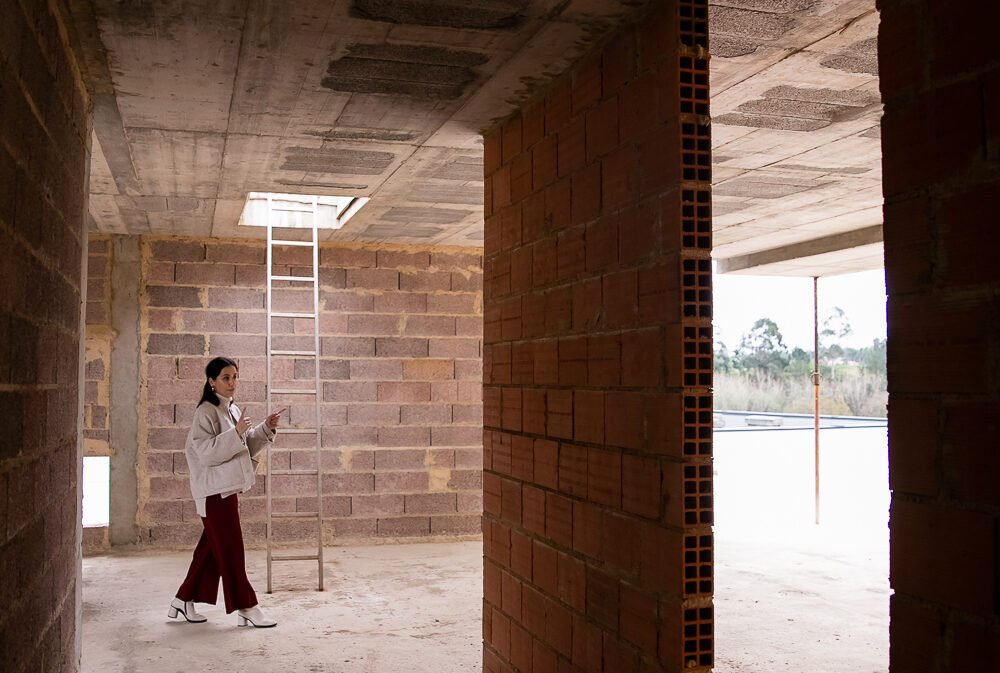
Rebuilding is not just about putting walls back up again.
Rebuilding is about learning to trust again. It is about reclaiming the idea of home as shelter, as a safe place, as a space of dignity.
In Portugal, architecture is still often seen as a luxury or as something reserved for those who can afford it, for those who “want something beautiful.” But the truth is that a dignified, safe, solid, and well-designed home should not be a privilegeIt should be a basic right.
The past few weeks have reminded us of this in the harshest possible way.
When time does not wait
Storm Kristin left a trail of destruction across several areas of the country. Roofs torn off, buildings weakened, homes flooded, families displaced. One week later, the country is still trying to recover when a new threat emerges: Storm Leonardo, forecast as yet another episode of heightened risk, especially for those with exposed roofs, already weakened structures, or who cannot simply “close the door and leave.”
The Plano Nacional de Emergência de Proteção Civil it was activated following a unanimous decision by the National Civil Protection Commission, in view of the forecast of increased risks to people and property. The message is clear: the situation is serious and requires an immediate response.
Mas o que estas situações expõem vai muito além da meteorologia.
A country that reacts, but does not prepare itself to ensure dignified housing.
Portugal responds well in emergencies. There is solidarity, there is an institutional response, there is mobilisation. But we prepare very little..
A large part of Portugal’s building stock is old, poorly maintained, or improvisedly adapted over decades. Aging roofs, structures that were never reinforced, ignored water infiltration, works carried out without a project or technical supervision. All of this creates buildings that are vulnerable not only to extreme weather, but to the simple passage of time.
When preventive maintenance, structural rehabilitation, or technical assessment of buildings is discussed, resistance still exists. Sometimes due to lack of knowledge, other times due to lack of resources. And almost always because architecture continues to be seen as something secondary, when in fact it is a tool for safety, public health, and resilience..
Rebuilding is costly. But not rebuilding costs more.
Rebuilding after a tragedy is always difficult. There are material, emotional, and economic losses. Starting from scratch is not a choice; it is a necessity.
But the real problem is that many of these reconstructions could have been avoided or minimised with better-prepared buildings, regular maintenance, and projects designed with the long term in mind, rather than merely addressing immediate needs.
The shortage of roof tiles, the lack of skilled labor, the endlessly extended deadlines—all of this reveals a system that only strains into action when it is already too late. Time is pressing, but the structural response remains slow.
Architecture as a collective responsibility
Thinking about architecture is not just about designing new homes. It is about looking at what already exists and asking:
– Is it safe?
– Is it prepared for the climate we have today and for what is still to come?
– Does it offer dignified living conditions to those who live there?
The rehabilitation of old buildings, the review of roofs, structural reinforcement, and adaptation to new climatic realities should not be exceptions. They should be policy, culture, and priority.
As long as we continue to treat architecture as an aesthetic luxury rather than an essential right,we will keep rebuilding in emergency mode instead of preventing with intelligence.
And it is also the responsibility of the State…
Faced with this reality, the State has been activating responses and support mechanisms for reconstruction and housing rehabilitation. After the destruction caused by Storm Kristin, the Government announced extraordinary measures to support affected families and businesses, including direct financial aid for housing reconstruction and simplified procedures in emergency contexts.
At the same time, there were already (and continue to be) structural programmes in place, such as support under the Plano de Recuperação e Resiliência (PRR), incentives for energy efficiency, urban rehabilitation funding calls, and tax benefits linked to building restoration. These are important and necessary steps. However, the gap between the existence of these supports and their effective application on the ground remains one of the major challenges: bureaucracy, lack of clear information, and a shortage of technical resources mean that many families are left stuck in limbo, precisely when time is the most critical factor.
(Re)building also means changing how we look at dignified housing
This is not a text about selling services, nor about assigning blame. It is an invitation to reflection.
Perhaps it is time to change the way we talk about architecture in Portugal.
To stop associating it only with the “new” or the “beautiful.”
And to begin recognising it for what it truly is: a foundation for life, for safety, and for dignity..
Because a home should not fail us when we need it most.
And because rebuilding, when it is unavoidable, should be accompanied by an essential question:
What kind of country do we want to build again?