
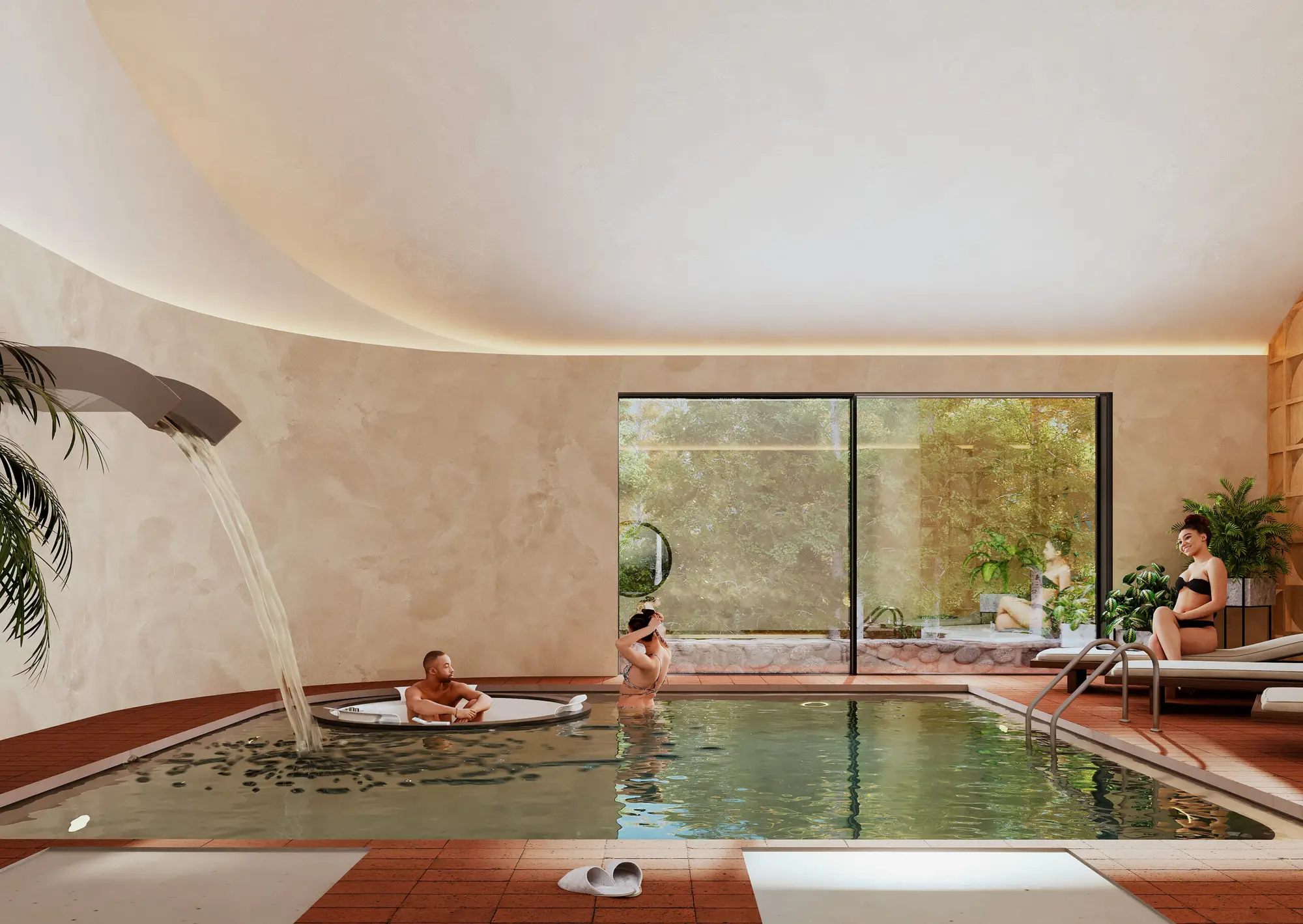
With the arrival of longer days and higher temperatures, there is a natural desire to transform the home into a more comfortable, cooler space suited to summer. In Portugal, this time of year not only marks the more intensive use of outdoor areas, but also the beginning of many architecture and renovation projects focused on thermal comfort and leisure..
Among these, building a swimming pool in Portugal stands out as one of the most sought-after interventions. However, before moving forward, there are several factors — legal, technical, and design-related — that are important to understand.
Summer architecture
When we think about “summer projects,” it’s common to associate them only with elements such as swimming pools, decks, or outdoor living areas. However, a good architectural approach goes far beyond that.
A house that is well designed for summer should take into account:
- Solar orientation:avoiding excessive heat gain during the hottest hours
- Natural and built shading: pergolas, trees, overhangs
- Cross ventilation: enabling natural cooling
- A fluid indoor–outdoor relationship:making better use of space
In other words, before considering a swimming pool, it is essential to ensure that the house itself already responds well to the climate.
Building a Swimming Pool in Portugal: What Does the Law Say?
The construction of swimming pools in Portugal is subject to specific regulations, which may vary depending on the municipality, but generally follow the principles set out in the legal framework for urban planning and building. (RJUE).
Planning permission or prior notification
In most cases, building a swimming pool involves:
- Planning permission, or
- Prior notification (depending on its size and location)
Even in private homes, a swimming pool is considered a construction project subject to urban planning control..
Mandatory Aspects to Consider
- Minimum distances from property boundaries
- Integration within the existing architectural design
- Impact on soil waterproofing
- Safety (especially in homes with children)
This information is based on the legal framework established by the Legal Regime for Urbanisation and Building (RJUE),which regulates all urban development operations in Portugal.
In classified areas or zones with planning restrictions, the requirements may be more stringent.
For this reason, it is not advisable to proceed without a technical project,which not only helps avoid legal issues but also ensures better performance and long-term durability.
Read also: Sustainability and Energy Efficiency in Portugal
Types of swimming pools: which one to choose?
Choosing a swimming pool should take into account its intended use, budget, and site conditions.
1. Concrete Pools (Traditional)
- More durable and highly customizable
- Allow for any shape or size
- Higher initial investment
2. Prefabricated Pools (Fiberglass or Liner)
- Faster installation
- More controlled costs
- Less design flexibility
3. Natural Pools
- Strong landscape integration
- Use of plants for filtration
- More demanding maintenance and balance
CURO Tip: swimming pools, water tanks, and their impact on property tax (IMI)
When planning to build a swimming pool, there is one aspect that is often overlooked: its tax implications. In Portugal, an in-ground pool is considered an element that adds value to the property and, as such, contributes to an increase in its taxable value, which may result in higher property tax (IMI).
In the case of solutions such as water tanks or above-ground pools (not built into the ground), the classification may be different, as they are not always considered permanent structures. This means that, in many cases, they do not have the same impact on the property’s taxable value..
Even so, this distinction does not depend solely on terminology, but rather on how the structure is executed and integrated into the overall project. More than a matter of naming, it is about understanding how each construction decision can influence not only the use of the space, but also the associated long-term costs.
Materials: what really makes a difference?
The choice of materials is one of the most critical factors, both for comfort and maintenance.
Interior finishes
- Ceramic or glass mosaic tiles:durable, aesthetic, and easy to maintain
- Liner:more affordable, but less durable
- Shotcrete (sprayed concrete) with finish:a robust solution
Pool surround (decking)
- Natural wood or composites:good thermal comfort, but require maintenance
- Natural stone:durable and visually appealing, but can retain heat
- Outdoor ceramics:good cost-benefit ratio, with a wide range of aesthetic options
Sustainability: can a swimming pool be efficient?
Yes, but it depends on the project.
Algumas boas práticas incluem:
- Thermal covers (reduce evaporation and heat loss)
- Efficient filtration systems
- Rainwater harvesting
- Integration with solar panels for water heating
In a country like Portugal, where water scarcity is an increasing concern, designing a pool with sustainability in mind is not just a choice, it is a responsibility.
The most common mistake: treating the pool as an isolated element
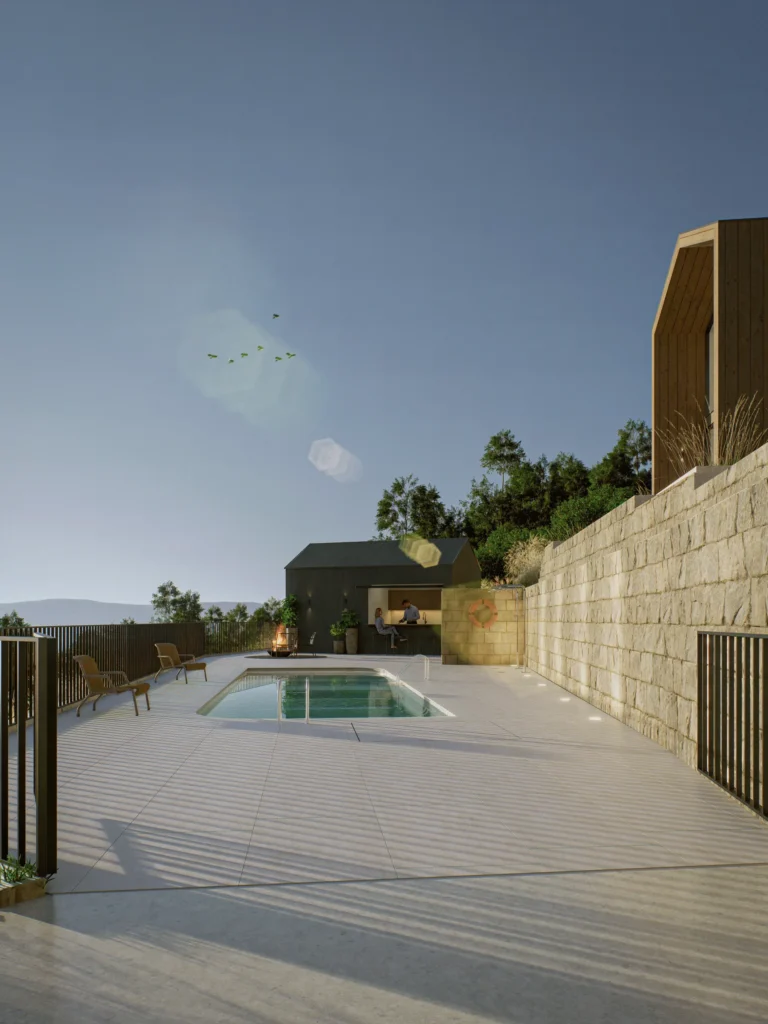
One of the most frequent misconceptions in residential projects is treating the swimming pool as a standalone feature, almost decorative, disconnected from the logic of the house and the site in which it is set. However, a pool is not merely an addition, it is an intervention that profoundly transforms how space is experienced.
When properly conceived, it becomes part of a broader system: it relates to the existing architecture, responds to solar orientation, creates areas of shade and exposure, defines circulation paths, establishes levels of privacy, and engages with the surrounding landscape. It is not simply about designing a body of water, but about shaping a coherent experience between interior and exterior.
It is this integration that distinguishes a functional project from one that is truly well resolved. A pool should not merely exist, it should make sense within its context. And when it does, it ceases to be an isolated element and instead enhances the whole, improving the way the space is lived and adding real value.
Designing for summer is designing better
With rising temperatures and increasingly evident climate change, designing the home for summer has become a strategic approach.
Architecture plays a fundamental role in this process, not only by creating more pleasant spaces, but also by reducing reliance on artificial systems and promoting natural comfort.
Before moving forward with a swimming pool or any outdoor intervention, speak with CURO's team.