
What does a public restroom say about a city?
When discussing urban architecture, people tend to think of iconic buildings, transportation infrastructure, or large public spaces such as squares and parks. However, seemingly ordinary elements reveal far more about a city's quality than one might expect. Public restrooms are one such silent element, often overlooked in architectural discourse,yet essential to the inclusivity, accessibility, and dignity of urban space.
This text proposes a closer examination of urban architecture through the lens of public restrooms, exploring their social, functional, and aesthetic dimensions. As a starting point, it will consider a contemporary and culturally significant case: the public toilets of Shibuya, Tokyo, and their portrayal in the film Perfect Days.
Public restrooms as essential urban infrastructure
From an academic perspective, the contemporary city is understood not merely as a collection of buildings but as a system of infrastructure that supports everyday life. Urban planning and urban design scholars, particularly those associated with the concept of the “city for people,” argue that the quality of public space depends on its ability to accommodate diverse bodies in different states of need.
Within this framework, public restrooms constitute a critical piece of urban infrastructure. Not only for the obvious physiological reasons, but also because they represent a direct commitment to social inclusion. A city that fails to provide dignified access to sanitary facilities is, in practice, excluding:
- older adults
- children
- people with disabilities
- people experiencing homelessness
- tourists and temporary users of urban space
Accessibility, therefore, is not limited to the provision of ramps or elevators. It also encompasses access to basic infrastructure that ensures hygiene, comfort, and privacy.
Accessibility as an urban experience: beyond regulatory compliance
In contemporary architecture, accessibility is often treated as a technical requirement. A more critical approach, however, understands it as an integral part of the urban experience.A truly accessible public restroom is not merely one that complies with regulatory standards and dimensional requirements, but one that takes into account:
- ease of location within the urban environment
- safe access, including adequate lighting, visibility, and the absence of hazardous areas
- the ability to be used independently, without assistance
- aesthetic integration with the surrounding environment
- consistent maintenance and cleanliness
At this point, architecture intersects with urban ethics. The way a city treats its most “invisible” spaces reveals much about its culture of care and its commitment to the well-being of all who use the urban environment.
The case of Tokyo: design, transparency, and social trust
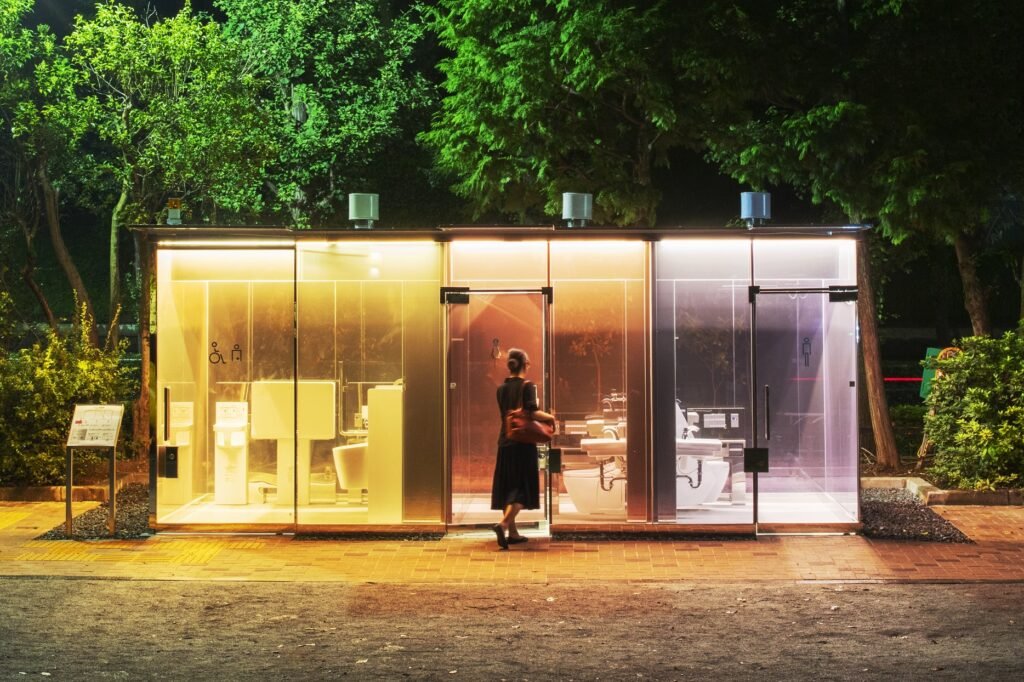
Tokyo is often cited as one of the world's most efficient cities in the management of public space. In recent years, a collection of public restrooms in the Shibuya district have become an internationally recognised example of architectural innovation.
Designed by renowned contemporary architects, these structures challenge the traditional perception of public toilets as neglected or marginal spaces. Instead, they are conceived as carefully crafted architectural objects, often minimalist in design and developed with close attention to the user experience.
Some of these facilities employ translucent materials that become opaque when occupied, introducing a fascinating reflection on trust, safety, and transparency in public space. More than a functional solution, they become an architectural experience in their own right.
"Perfect Days" and the poetics of everyday urban life
It is within this context that the film Perfect Days becomes particularly relevant to a contemporary reading of urban life. The film follows the daily routine of a man who works cleaning public restrooms in Tokyo, transforming an apparently invisible occupation into a repetitive act of care, routine, and contemplation.
The film is not merely about urban hygiene. Rather, it offers a profound reflection on the value of what is often overlooked in the city. Public restrooms cease to be secondary spaces and instead become central to a narrative about dignity, repetition, and presence within the urban environment.
From an architectural perspective, Perfect Days suggests a powerful idea: the most humble spaces in a city may be the most revealing when it comes to understanding how we live together.
The city as a system of care
When viewed through this lens, urban architecture is revealed to be more than the creation of forms and structures; it is also a framework for relationships of care. Public restrooms, benches, shaded areas, drinking fountains, and street lighting are not secondary details. They are essential infrastructures that contribute to collective well-being.
In this sense, the city can be understood as a system that supports everyday life. A well-designed city is not only efficient or aesthetically pleasing, but also empathetic.
The presence (or absence) of adequate public restrooms has a direct impact on how people inhabit urban space. It can determine how long someone remains in a public area, which routes they choose to take, or even whether they feel comfortable leaving their home in the first place.
Implications for contemporary urban design
For architects, urban planners, and policymakers, the discussion surrounding public restrooms raises a number of fundamental questions:
- How can essential yet discreet infrastructures be integrated without compromising the aesthetic quality of the city?
- How can continuous maintenance be ensured without turning public space into an environment of excessive surveillance and control?
- How can spaces be designed to be genuinely inclusive for diverse populations and users?
These questions highlight the fact that urban architecture is not merely a discipline concerned with form. It is also deeply connected to the social and political management of space.
The invisible infrastructure that sustains the city
Public restrooms are rarely at the centre of discussions about urban architecture, yet perhaps they should be. They bring together some of the most important issues facing the contemporary city: accessibility, dignity, maintenance, and inclusion.
The case of Tokyo, together with the cultural perspective offered by Perfect Days, demonstrates that even the most ordinary spaces can be transformed into architectural experiences and deeply human narratives.
For CURO, this perspective on the city is essential. It encourages us to think of architecture not merely as the act of building, but as an ongoing practice of caring for shared space, including its most overlooked and invisible places.